
 Descargar App
Back to blog
guidesHow to hit a good drive: technique, setup and when to leave the driver in the bag
The driver is the only club you hit on the way up. The correct setup, ball forward, high tee, where distance really comes from, and which holes are better without it.
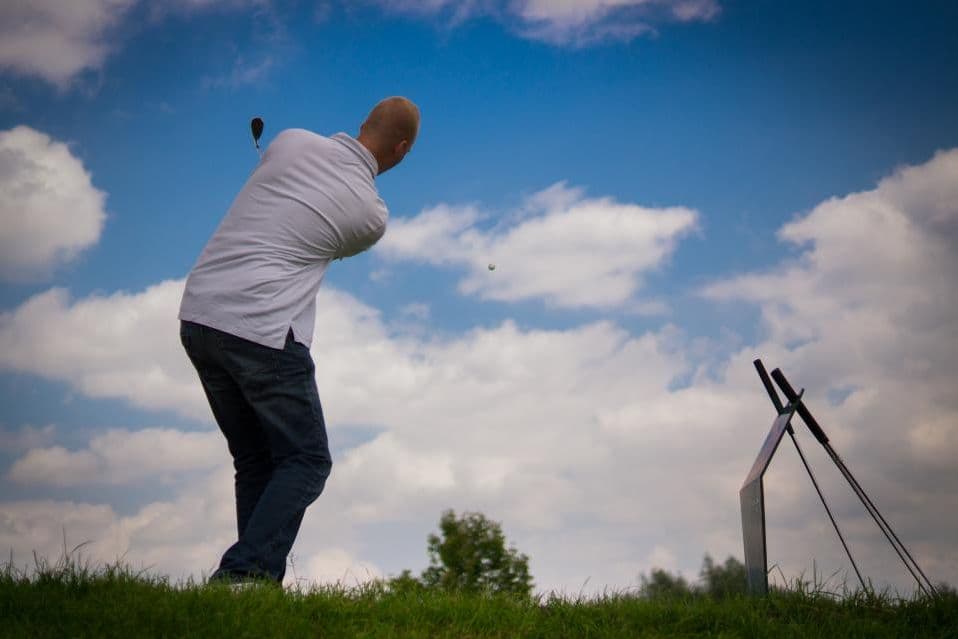
How to hit a good drive
The driver is the most exciting club in the bag and the one that ruins the most scorecards. The reason is that most people hit it as though it were an iron.
It isn't. It is the only club you hit upwards, and until that sinks in, no swing tip is going to work for you.
The fundamental difference: iron down, driver up
| Iron | Driver | |
|---|---|---|
| The ball sits | On the ground | On a tee |
| The club arrives | Descending | Ascending |
| You want to | Compress the ball against the ground | Pick it up on the way through |
| It leaves | A divot | Nothing, or a brushed tee |
| Ball position | Centre or slightly forward | Left heel |
With an iron you strike the ball first and the ground second. With a driver, hitting down creates backspin, the ball balloons and you lose 20 or 30 metres. An ascending angle of attack is where driver distance comes from, more than force.
The setup: where 80 % of it is won
Almost every bad drive is already lost before the club moves.
(01) Ball in line with the left heel. Not centre. All the way forward. This makes the club find it after the low point of the arc — that is, on the way up.
(02) High tee. The top half of the ball should sit above the top edge of the driver face. With today's large heads that means a tee noticeably higher than most people use.
(03) Wide stance. Feet slightly wider than the shoulders. It is the longest club and you need a base.
(04) Right shoulder lower than the left. You get there by tilting the spine slightly away from the target. It should feel as though your right ear is closer to your shoulder. That tilt is what creates the ascending angle without you having to do anything strange during the swing.
(05) Weight slightly back. About 55 % on the right foot at address. The opposite of your irons.
Do these five things and change nothing else about your swing, and your drives will already improve.
The swing: three things, and none of them is "hit harder"
Rhythm, not force. The most repeated advice in golf and the most ignored. When you accelerate from the top, the club arrives out-to-in and off-centre. A swing at 85 % with a centred strike flies further than one at 110 % off the toe. Much further.
Turn, don't sway. The backswing is a rotation of the shoulders around the spine, not a shift of the body to the right. If your hip slides outside, you have lost your centre and you will not get back to the ball.
The downswing starts from the ground. Weight to the left foot, then hips, then torso, arms last. Start with the shoulders or arms and the club comes down outside, producing a slice. Covered in how to fix a slice in golf.
Where distance actually comes from
In order of importance — and it is not the order people assume:
(01) A centred strike. A shot from the middle of the face flies 15 to 25 metres further than one two centimetres towards the toe, at identical swing speed. It is by far the number one factor.
How to check: foot spray or an impact sticker on the driver face. Ten balls and you will see exactly where you are striking it. Almost nobody runs this test and almost everybody is surprised.
(02) Clubhead speed. It does matter, but it is the hardest thing to improve and the slowest. You build it with specific speed training and with hip and torso mobility, not by swinging harder.
(03) Angle of attack. Every degree of upward strike adds metres. Hence the setup above.
(04) The equipment. Driver loft, flex and length. A medium-speed player using a 9-degree head with an S shaft is leaving metres on the table that 11 degrees and an R shaft would return. Explained in which golf clubs you actually need to start.
Note that "hit it harder" does not appear on the list.
When not to use the driver
This section is worth more shots than all the technique above.
The driver is the longest club and the least forgiving. Its lateral dispersion is roughly double that of a 3-wood. And on many holes those extra 20 metres buy you nothing.
Leave the driver in the bag when:
- The fairway is narrow, or there is water or out of bounds down one side.
- The hole doglegs and the extra distance runs you into the rough on the turn.
- It is a short par 4 and a 3-wood leaves you a comfortable wedge.
- On a par 5 you cannot reach in two anyway. Here the driver adds nothing at all: split the hole into three comfortable shots.
- Your last three drives have gone offline. It is not your driver day; accept the information.
A concrete test: play three rounds using the driver only on wide holes. Compare your cards. Most players score better without changing anything else.
Four drills
(01) Tee, no ball. Set a tee and make swings trying to brush it just after the low point. It trains the ascending strike without the pressure of a ball.
(02) The impact sticker. Ten balls with spray or a sticker on the face. If the pattern is towards the toe or heel, that is your work before anything else.
(03) At 70 %. Ten drives at 70 % of your speed. Count how many find the fairway and compare with your normal drives. The result is usually uncomfortable and very useful.
(04) Feet together. Five balls with your feet touching. It is impossible to swing hard, so the body learns to sequence properly out of necessity. Go back to a normal stance afterwards and you will feel the difference.
The Teeup Academy has these drills with scoring and targets by level, so you know whether you are genuinely progressing.
Frequently asked questions
Where should the ball be for a driver? In line with the left heel (for right-handers), all the way forward in the stance.
How high should I tee it? High enough that the top half of the ball sits above the top edge of the driver face.
How can I drive the ball further? In this order: centred strike, ascending angle of attack, clubhead speed and suitable equipment. Swinging harder usually costs distance rather than adding it.
Why does my ball balloon and come up short? Almost always because you are hitting down on the driver, or because the loft or shaft does not suit you.
How far should I hit my driver? An average male amateur, 185 to 210 metres. An average female amateur, 145 to 165. Full figures in golf club distances.
Is a 3-wood better than a driver for a beginner? For many beginners, yes. It is shorter, easier to control, and you lose fewer metres than you think.
A good drive is not a long one: it is one that finds the fairway. A player who hits it 180 metres in play scores better than one who hits it 220 into the rough, and the card proves it every Sunday.
The Teeup Academy has long-game drills with tracking, and the app has the course network to test them.
Download the Teeup app and book your next round.