
 Descargar App
Back to blog
guidesGolf club distances: how far each club actually goes
Distance charts by club in metres and yards for three player profiles, how to measure your real numbers in one session, and why almost everyone credits themselves 15 metres too many.
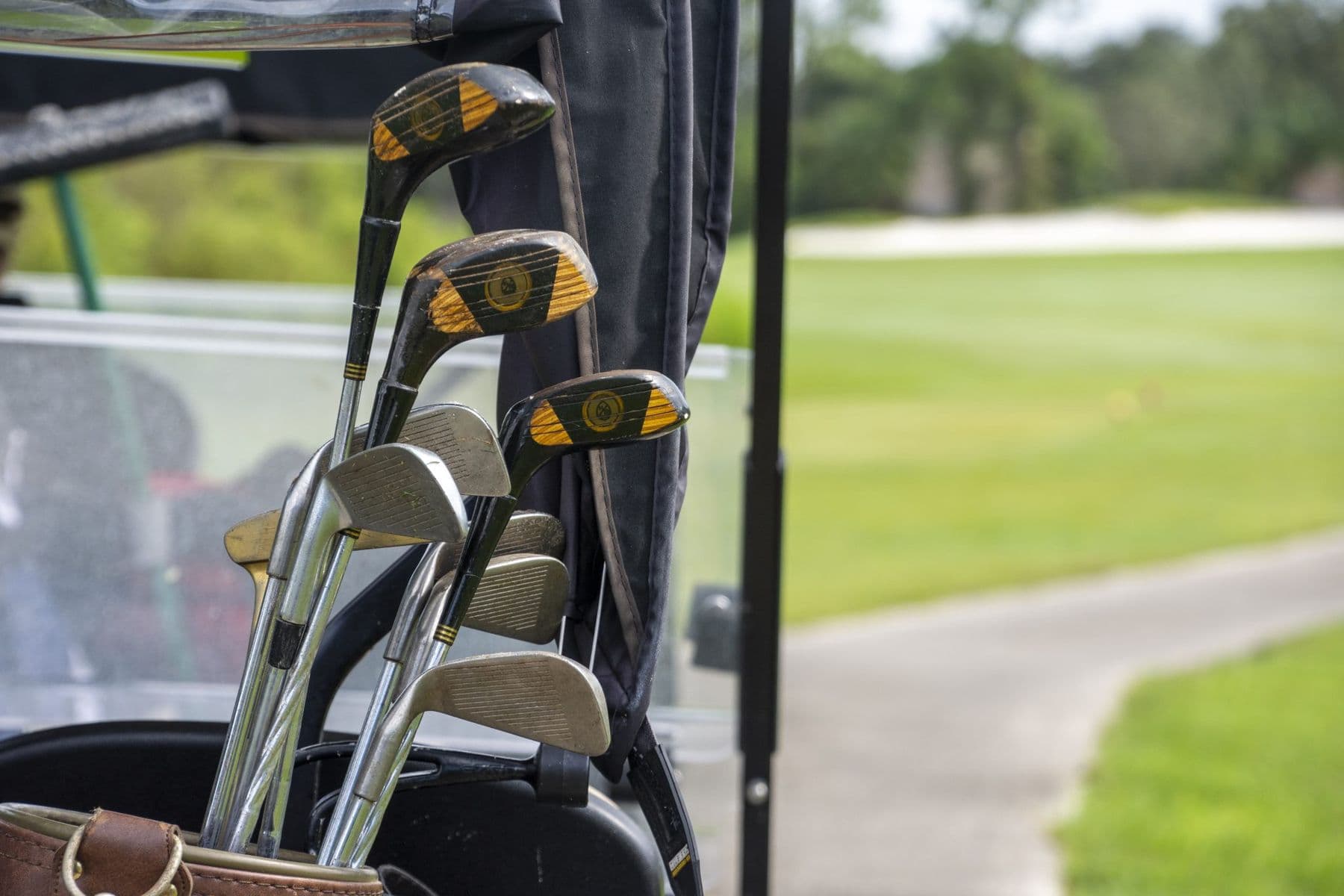
Golf club distances
Ask an amateur how far they hit a 7-iron and you will get a number. That number is almost never their distance: it is the best 7-iron of their life, the one they hit three months ago downhill with the wind behind.
That 10 or 15 metre gap between what you believe and what you do is why so many approach shots finish in the front bunker.
The charts: what is normal for your profile
All figures are carry plus roll in neutral conditions (no wind, normal ground, sea level). They are indicative: you measure your own chart, and we explain how below.
Slower swing speed
Driver below 90 mph. This covers most amateur women and many senior or beginner men.
| Club | Metres | Yards |
|---|---|---|
| Driver | 145-165 | 160-180 |
| 3-wood | 130-145 | 140-160 |
| 5-hybrid | 115-130 | 125-140 |
| 6-iron | 105-115 | 115-125 |
| 7-iron | 95-105 | 105-115 |
| 8-iron | 85-95 | 95-105 |
| 9-iron | 75-85 | 82-95 |
| Pitching wedge | 65-75 | 70-82 |
| Sand wedge | 45-60 | 50-65 |
Medium swing speed
Driver between 90 and 103 mph. The average male amateur, handicap 15-25.
| Club | Metres | Yards |
|---|---|---|
| Driver | 185-210 | 200-230 |
| 3-wood | 165-185 | 180-200 |
| 4-hybrid | 150-165 | 165-180 |
| 5-iron | 140-155 | 155-170 |
| 6-iron | 130-145 | 142-158 |
| 7-iron | 120-135 | 130-148 |
| 8-iron | 110-125 | 120-137 |
| 9-iron | 100-115 | 110-125 |
| Pitching wedge | 90-100 | 98-110 |
| Gap wedge | 75-88 | 82-96 |
| Sand wedge | 60-75 | 65-82 |
Higher swing speed
Driver above 103 mph. Low handicappers or players with good natural speed.
| Club | Metres | Yards |
|---|---|---|
| Driver | 220-250 | 240-275 |
| 3-wood | 200-220 | 220-240 |
| 3-hybrid | 180-195 | 195-215 |
| 5-iron | 165-180 | 180-195 |
| 7-iron | 140-155 | 155-170 |
| 9-iron | 115-130 | 125-142 |
| Pitching wedge | 105-115 | 115-125 |
| Sand wedge | 75-90 | 82-98 |
The figure that matters more than the chart: the gapping. There should be 10 to 15 metres between consecutive clubs. If two clubs go the same distance, one is redundant. If there is a 25-metre hole, you are missing a club.
How to measure your real distances in one session
Forty minutes on the range and you never guess again.
- Pick five clubs, not all of them: driver, a hybrid or wood, 7-iron, 9-iron and pitching wedge. From those five you can interpolate the rest.
- Ten balls with each, finishing one club before moving on.
- Discard the two best and the two worst. Yes, the best too. That brilliant strike is not representative and it is exactly the one misleading you.
- Average the remaining six. That is your distance.
- Note the shortest of those six as well. That is your safety distance, the one you use when there is water in front of the green.
If the range has marked flags, they work. A rangefinder works better. And a simulator or launch monitor is better still: it gives you clean carry, which is the number that matters when there is a bunker short.
Repeat it twice a year. Distances shift with fitness, temperature and equipment.
What changes your distances on the course
Your chart is the baseline. These factors move it:
| Factor | Approximate effect |
|---|---|
| 15 km/h headwind | -10 to -15 metres |
| 15 km/h tailwind | +7 to +10 metres |
| Every 300 m of altitude | +2 % distance |
| Cold (below 10 °C) | -5 to -8 metres |
| Heat (above 30 °C) | +3 to +5 metres |
| Wet ground | You lose almost all the roll |
| Ball above your feet | Starts more left and flies slightly shorter |
| Uphill shot | One more club |
| Downhill shot | One less club |
Rule of thumb into wind: double what you think. Almost everyone comes up short because they allow for half of what is needed and then swing harder, which balloons the ball and exposes it further.
The error that costs most shots: coming up short
Any Sunday on any course tells the same story the amateur statistics do: most missed approaches finish short, not long.
Three reasons:
- You use your best distance, not your average.
- You don't account for the flag: you measure to the middle of the green while the pin is at the back.
- The trouble is almost always in front — bunkers, slopes, water — and the free space is behind.
The fix: take one more club than you were going to. It sounds simple because it is, and it is the single biggest shot-saver in the long game.
When the problem is the clubs, not you
Two signs your equipment does not fit:
Your distances don't gap. If your 6 and 7 go the same distance, or the gap between pitching and sand wedge is 30 metres, you have a loft problem, not a technique problem. Modern sets have progressively strengthened lofts — today's 7-iron has the loft of a 5-iron from twenty years ago — and that leaves holes at the bottom of the bag.
You hit it short with a low flight. Usually a shaft that is too stiff. It is the same pattern that produces a slice, explained in how to fix a slice in golf.
Both are settled by measuring. At Teeup you can do indoor fitting and see your real numbers club by club before buying anything.
How to use your distances to save shots
Having the chart is useless if you still pick clubs on instinct.
- Choose by distance to the flag, not to the green. Always measure to the middle and adjust.
- Use your average, not your maximum. The maximum turns up one time in ten.
- When torn between two clubs, take the longer one and swing easy. One more club at 85 % is more reliable than one less at 110 %.
- With water or a bunker short, use your safety distance — the worst of your six good ones.
The other half of the equation is lateral dispersion: how far offline the ball goes, not just how far it flies. We cover that in how to lower your score without changing your swing.
Frequently asked questions
How far does an average 7-iron go? An average male amateur is between 120 and 135 metres. An average female amateur, 95 to 105. It depends far more on swing speed than on sex or strength.
How far should a beginner hit a driver? Between 145 and 185 metres is entirely normal. The 250-metre drives on television come from swing speeds an amateur rarely reaches.
How many metres between clubs? Ten to fifteen in a well-gapped set. Under 8 means one club is redundant; over 20 means one is missing.
How do I measure my real distances? Ten balls per club, discard the two best and two worst, average the remaining six.
Should I use metres or yards? Spanish courses mark in metres. A yard is 0.91 metres: to convert yards to metres, subtract 9 %.
Does the ball affect distance? Less than the marketing suggests. Compression matters somewhat at low speeds, but for an amateur the difference between balls is far smaller than the difference between a good and a bad strike.
Knowing your real distances is the cheapest improvement available in golf: forty minutes on the range, a notebook, and you play on information instead of memories.
If you suspect the equipment is the problem, Teeup offers fitting and clubs built to your measurements.
Download the Teeup app and book your next round.