
 Descargar App
Back to blog
learnWhich golf clubs you actually need to start (and which ones you don't)
The rules allow 14 clubs and you will use 7. The five families explained, the half set that covers 95 % of your shots, and why the shaft matters more than the brand.
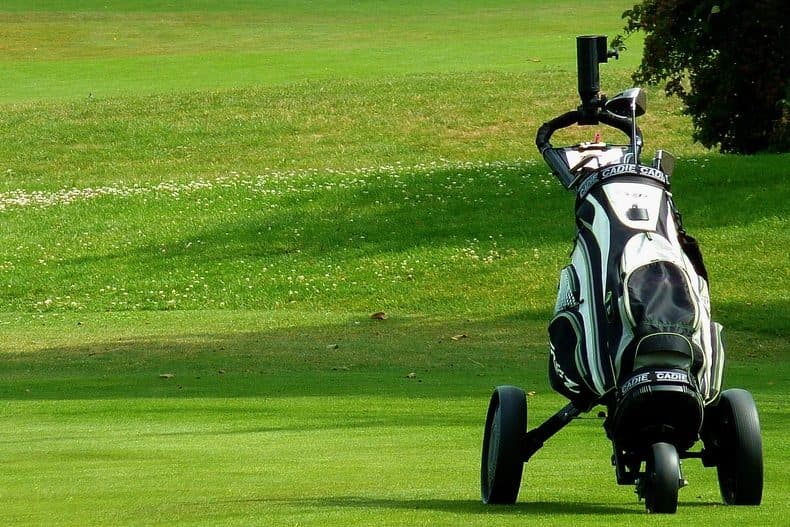
Which golf clubs you actually need to start
Seven. That is the short answer. The rules let you carry 14, shops sell you sets of 12, and you will use 7 for your first two years.
This is not about buying cheap. It is about buying in the right order. A beginner with seven clubs that suit them plays better — and enjoys it more — than one with fourteen they never chose.
What is in a golf bag and what each thing does
Five families, ordered by how far the ball goes and how much control you get.
| Family | Clubs | Rough distance (amateur) | What for |
|---|---|---|---|
| Woods | Driver, 3-wood, 5-wood | 160-230 m | Tee shots and long shots from the fairway |
| Hybrids | 3, 4, 5 hybrid | 130-180 m | Replace long irons, far easier to hit |
| Irons | 4 through 9 | 90-160 m | The bulk of your game: approaches to the green |
| Wedges | Pitching, gap, sand, lob | 30-110 m | Short game, bunkers, everything inside 100 m |
| Putter | 1 | — | The green. A third of your shots |
The detail nobody tells you: every club has a loft (the angle of the face), and that angle decides how high the ball goes and how far it flies. A driver has 9-12 degrees and sends the ball far and low. A sand wedge has 54-56 and sends it high and short. Everything else is stepped in between.
The half set: the 7 clubs that cover 95 % of your shots
- Driver or 3-wood. If the driver is a struggle, start with the 3-wood: shorter, easier to control, and you lose fewer yards than you think. If you do buy a driver, go for high loft (11-12 degrees) — most beginners hit it better.
- 4 or 5 hybrid. The most underrated club in amateur golf. It does what a 4-iron does but forgives strike errors a 4-iron punishes.
- 7-iron. The club you will learn to strike with. If you could only carry one, this would be it.
- 9-iron.
- Pitching wedge.
- Sand wedge. Essential from day one: it is what gets you out of a bunker.
- Putter.
The gaps you leave out (5, 6 and 8 irons, higher woods, gap wedge) are gaps a beginner cannot yet exploit. When you start noticing "between the 7 and the 9 I'm missing something", that is the moment. Not before.
Bonus: the bag weighs half as much, and walking 18 holes with seven clubs is a different experience.
New, second-hand or rented
Rented (€0-25 per round). For your first outings. Buy nothing before your sixth round.
Second-hand (€150-350 for a half set). The best value in golf. A five-year-old high-end iron set outperforms a current entry-level one and costs less. Golf equipment loses value fast but performance very slowly.
New (€600+). Once you play regularly, know your distances and know what is missing.
Budget rule: spend more on the putter and wedges than on the driver. You use the driver 14 times a round. The putter, 30 to 40.
What actually matters: shaft, flex and lie
This is where equipment stops being marketing and becomes physics.
The shaft matters more than the head. It is what transmits your speed to the ball. Two 7-irons with the same head and different shafts behave like different clubs.
Flex is how much that shaft bends. It runs from L (softest) to X (stiffest), through A, R and S. The more clubhead speed, the stiffer you need. Beginners usually need R or A, and most end up playing shafts that are too stiff because they bought a set designed for somebody else. Classic symptom: the ball comes out low and to the right no matter how much you fix your technique.
Steel or graphite. Graphite is lighter and helps generate speed; steel gives more control and feel. The standard starting combination is graphite in woods and hybrids, steel in irons — but with low swing speed, graphite throughout is perfectly valid.
Length and lie. Lie is the angle between the shaft and the ground when you set the club down. If it does not match your height and posture, the face arrives open or closed at impact and the ball leaves to one side systematically. It is one of the cheapest, highest-impact adjustments there is: you fix it by bending the club, not by buying another one.
What about fitting? Isn't that for good players?
That is the most widespread belief and the most wrong.
Fitting is not "improving good clubs". It is measuring how you swing and choosing equipment that matches. And the beginner has the most to gain: where a low-handicapper picks up 5 % consistency, a beginner can eliminate outright a fault they spent months trying to fix with technique when it actually came from the wrong shaft.
When it makes sense:
- You are about to spend more than €500 on clubs. Fitting is not an extra; it is what stops you spending that €500 badly.
- You have a persistent fault that lessons do not fix.
- You are outside the average in height, swing speed or hand size.
When it doesn't: if you do not yet have a repeatable swing. Measuring a movement that changes weekly gives no useful data. Take three or four lessons first.
At Teeup you can do indoor fitting and buy clubs already adjusted to your measurements, instead of picking one of three sets off a shelf.
The five most expensive club-buying mistakes
(01) Buying the full set in month one. You will end up with four clubs that never leave the bag.
(02) Buying by brand. The name on the head matters far less than the flex of the shaft.
(03) Inheriting somebody's clubs. They were built for their height, their speed and their swing. As a gift it is a lovely gesture; as equipment it is usually a handicap.
(04) Ignoring the wedges and the putter. They are half your shots and usually the last thing you spend on. It should be the other way round.
(05) Buying a 10.5-degree driver because "that's normal". More loft means more height, more stable flight and less sidespin.
Looking after them
- Clean the grooves on your wedges and irons after every round. A groove packed with dirt stops generating spin and the ball flies long with no control.
- Check your grips once a year. A slick grip forces you to squeeze harder, and a tense hold ruins the whole swing. Regripping is cheap and you feel it immediately.
- Dry the clubs before storing them, and don't leave the bag in the boot of the car all summer.
Frequently asked questions
How many clubs can I carry? A maximum of 14 under the rules. There is no minimum: you can play with one.
What clubs should a beginner carry? Seven: wood or driver, a hybrid, 7-iron, 9-iron, pitching wedge, sand wedge and putter.
Hybrid or long iron? For nearly all amateurs, the hybrid. Wider head, lower centre of gravity, far more forgiving.
Is it worth buying second-hand clubs? Very much so. A five-year-old high-end set is an excellent buy, as long as the flex and length suit you.
At what level does fitting make sense? As soon as you have a minimally repeatable swing and are about to spend real money on clubs.
What flex do I need? It depends on your swing speed, not your strength. The only serious way to know is to measure it. As a guide, most beginners do better on R or A than on S.
How often should I replace my clubs? Irons last many years. What gets replaced regularly are grips (annually) and, if you improve a lot, the shaft.
Before you buy anything, measure. And before you measure, play a few rounds with rental clubs so you know what kind of player you are going to be.
When the time comes, Teeup offers fitting and clubs built to your measurements, plus the app to book a green fee wherever you want to test them.
Download the Teeup app and book your next round.