
 Descargar App
Back to blog
guidesIndoor golf in Spain: what it is, how it works and where to practise
Indoor golf has arrived in Spain to stay. We explain what it is, how simulators work and why more and more golfers are training under a roof.
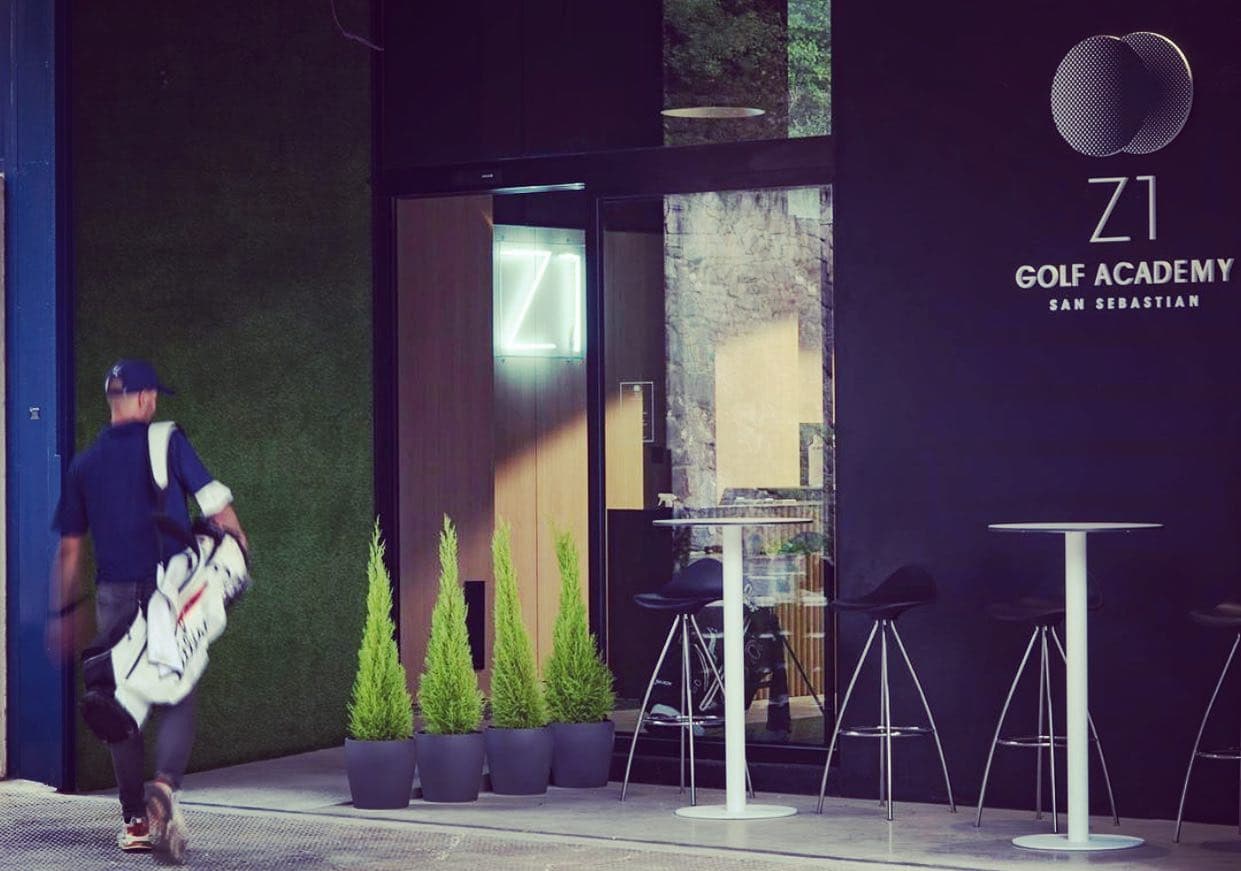
Until a few years ago, indoor golf in Spain barely existed. An expensive simulator at some private club, perhaps a putting area at a luxury hotel. Not much else.
That has changed. And it has changed fast.
Today there are specialist centres in several Spanish cities that allow golfers to practise year-round, regardless of the weather, without travelling to a course and at a fraction of the cost of a conventional round.
This guide explains what indoor golf actually is, how simulators work, which type of golfer it makes sense for, and where to find it.
What is indoor golf
Indoor golf is the practice of golf in enclosed spaces using high-technology simulators. The player hits a real ball with their own clubs, in front of a screen that reproduces a virtual golf course in real time. Sensors capture all the parameters of the shot and the screen shows the trajectory, landing and result.
It is not a video game. No buttons are pressed. It is real golf: the same mechanics, the same swing, the same clubs. What changes is that the course exists in digital format and the environment is indoors.
How simulators work
Modern golf simulators use a combination of high-speed cameras, Doppler radar and impact sensors that analyse the shot in a fraction of a second.
The parameters a professional simulator captures include:
Ball Speed: the speed of the ball leaving the clubface. It is the most direct measure of the power of the strike.
Club Head Speed: the speed of the clubhead at the moment of impact. In advanced players it can exceed 120 mph.
Launch Angle: the angle at which the ball leaves the club. It determines, together with spin, whether the shot flies too high, too low or on the ideal trajectory.
Spin Rate: the revolutions per minute of the ball. Backspin controls distance and landing; sidespin determines left or right curvature.
Smash Factor: the efficiency of the strike, calculated by dividing ball speed by club head speed. The ideal value with a driver is between 1.48 and 1.50.
Carry and total distance: the distance the ball travels through the air and the total distance including the bounce.
With all this data, the simulator calculates the real trajectory that shot would have had on the virtual course and reproduces it on screen. The accuracy of the best equipment on the market is very high — the same simulators used by PGA Tour players for their swing analysis.
Why golfers choose indoor
There are several reasons why indoor golf has gained fans in Spain, and not all of them are about the weather.
Training continuity. Golf requires constant practice. Rain, cold, or simply a lack of time to travel to the course interrupt that rhythm. A simulator allows players to maintain their physical and technical form for weeks without going outside.
Detailed swing analysis. On the course you can see if a shot was good or bad. In a simulator you know exactly why. Real-time data makes it possible to identify patterns, correct errors and work on specific aspects of the game with a precision impossible to achieve through course practice alone.
Playing iconic courses. Professional simulators include courses such as Pebble Beach, St Andrews, Augusta National and Valderrama in their libraries. Playing a round at Pebble Beach from San Sebastián is possible.
Cost per round. A 60-90 minute simulator session costs between €20 and €40 at most Spanish centres. An 18-hole round at a private course can cost between €60 and €150. For a golfer who wants high volume at a reasonable cost, the mathematics is clear.
Accessibility for beginners. The indoor environment removes many of the psychological barriers of the course: no other players watching, no pace of play to maintain, no penalty for a lost ball in the rough. For someone starting out, it is a much more comfortable environment to learn in.
Indoor golf vs. the course: are they compatible?
The short answer is yes, and the best players combine them.
Indoor is excellent for technical analysis, practice volume, working on specific areas of the game (driver, irons, approach) and maintaining your swing during winter or periods of limited availability.
The course offers what the simulator cannot fully replicate: variable terrain, ball lies in the rough, the effect of real wind, reading greens, and above all the mental dimension of playing with real consequences.
The optimum is to use indoor as a complement to the course, not a substitute. Many mid and advanced level players do simulator sessions during the week and save the course for the weekend.
What is golf fitting and why indoor is the best place for it
Golf fitting is the process of personalising golf equipment — clubs, lofts, flexes, lengths, grips — according to the physical and biomechanical characteristics of each player.
A poorly done fitting can mean you are using clubs with the wrong flex for your swing speed, a driver loft that costs you 15 metres of distance, or irons that are too short for your posture. Many players who think the problem is their swing are actually using equipment that does not suit their game.
The indoor environment is ideal for fitting because the simulator data is objective and repeatable. The fitter can see in real time how each combination of club, flex and loft responds to the player's swing, and find the configuration that maximises their performance.
Teeup works with Z1 Golf Academy, the leading indoor reference centre in Spain, which offers professional fitting sessions with access to the main brands on the market. One of Teeup's key features is precisely facilitating access to premium equipment at the best prices available online, thanks to this partnership.
Where to practise indoor golf in Spain
The ecosystem of indoor centres in Spain is growing, although the geographical distribution is still uneven. The cities with the most options are Madrid, Barcelona and San Sebastián.
In the Basque Country, Z1 Indoor Golf in San Sebastián is the benchmark centre. It has Trackman simulators, certified professional tuition, fitting sessions and the possibility of playing the world's best courses. It is the space with which Teeup has a direct partnership, giving Teeup members access to special conditions at their facilities.
In Madrid, centres such as El Retiro Golf have opened indoor spaces in the city centre, reducing access barriers for urban golfers.
The trend is clear: in the coming years, the number of indoor centres in Spain will continue to grow. The model has worked throughout northern Europe for decades, and the Spanish market is in a phase of rapid adoption.
Who benefits from indoor golf
Indoor golf is not only for advanced players. It makes sense for very different profiles:
The complete beginner who wants to learn without the pressure of the course and with immediate feedback on every shot.
The regular player who wants to maintain their level during winter or periods when time is limited.
The player working on technique who works with a professional and needs quality repetition with objective data.
The business or travelling golfer who wants to play without leaving the city, in small groups and in a comfortable setting.
The golfer who has never had a fitting and wants to know whether their equipment is limiting their performance.
With Teeup you can book sessions at associated indoor centres, access the benefits of the Z1 partnership and always find the most suitable option for your level and goals.
Download Teeup and discover indoor golf.