
 Descargar App
Back to blog
guidesHow the golf handicap works: a complete updated guide
Everything you need to know about the WHS handicap system: how it is calculated, what Course Rating and Slope Rating mean, and how to improve your index.
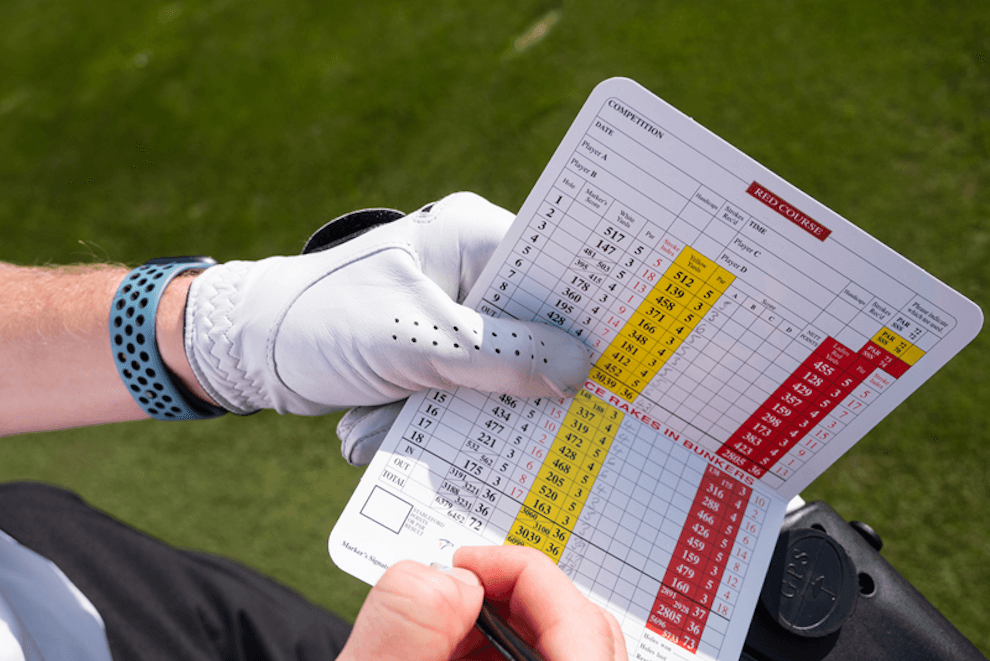
The handicap is one of the most talked-about concepts in golf and, paradoxically, one of the least understood. Most players know they have a number and that it helps level the playing field. But few know exactly how it is calculated, why it goes up or down, or what that number actually means.
This is the guide that explains the system from scratch, without taking anything for granted.
What is a golf handicap
A handicap is a number that represents a golfer's playing ability. Its purpose is to allow players of different levels to compete on equal terms. The lower the handicap, the better the player.
A player with a handicap of 10 would be expected to complete a standard course in 82 strokes (72 par plus 10 handicap). A player with a handicap of 28 would be expected to complete the same course in 100 strokes. The system bridges that gap so both can compete fairly.
Since 2020, the official system in Spain and worldwide is the World Handicap System (WHS), unified under a single global methodology.
The WHS: the foundation of everything
Before the WHS, there were six different handicap systems around the world, and they were not compatible with each other. A player with an 18 handicap in Europe was not equivalent to one with an 18 handicap in the United States. This made international mobility and fair competition difficult.
The WHS unified everything. Today, a golfer can play at any course in the world with a recognised handicap, and that number carries the same meaning in Spain, Ireland or Australia.
In Spain, the managing body for the WHS is the Real Federación Española de Golf (RFEG). If you play at a federated club or use a recognised app, your handicap is registered in the official system.
How the handicap is calculated
The WHS does not use a simple average of your scores. It uses a more sophisticated system that rewards consistency and penalises bad rounds less.
The Score Differential
Every round you play generates a Score Differential. This is the unit of calculation in the WHS and is obtained with the following formula:
Score Differential = (Adjusted Score − Course Rating) × 113 / Slope Rating
There are three variables here worth understanding properly.
Adjusted Score: this is your actual result on the course, with a maximum per hole. Under WHS, the maximum per hole is the hole's par plus the number of additional strokes you are entitled to based on your handicap, plus two more. This prevents a very bad round from distorting your handicap excessively.
Course Rating: this is the estimated difficulty of the course for a scratch golfer (handicap 0) under normal conditions. A course with a Course Rating of 71.4 is slightly easier than par if you are scratch. A course with a Course Rating of 74.2 is harder. This number is determined by a team of certified assessors from the governing body.
Slope Rating: this measures the difficulty of the course for a bogey golfer (approximately handicap 17-18 for men) relative to the scratch golfer. The standard Slope Rating is 113. A course with Slope 130 is significantly more difficult for average players than for scratch golfers.
Calculating the Handicap Index
With your Score Differentials, the WHS calculates your Handicap Index. The process works as follows:
- The system takes your last 20 recorded rounds.
- From those 20, it selects the 8 best Score Differentials.
- It calculates the average of those 8 differentials.
- It applies a factor of 0.96 (96% of the average).
The result is your Handicap Index, expressed to one decimal place.
Why the 8 best and not the average of all? Because the WHS is designed to reflect your potential, not your average performance. The idea is that your handicap represents what you can do when you play well, not on a difficult day.
From Handicap Index to Course Handicap
Your Handicap Index is your global reference number. But when you play at a specific course, that number becomes a Course Handicap, which is what appears on the scorecard.
Course Handicap = Handicap Index × Slope Rating / 113 + (Course Rating − Par)
If your Handicap Index is 15 and you play at a course with Slope 125 and a Course Rating equal to par, your Course Handicap will be approximately 17. At an easier course with Slope 100, it will be around 13. The system automatically adjusts for the difficulty of each course.
How the handicap is updated
Every time you record a valid round, the system recalculates your Handicap Index. The update is virtually immediate on federated platforms.
When does it go up and when does it go down?
Your handicap falls when you play above your usual level: your recent rounds generate better Score Differentials than previous ones, the best 8 of the last 20 improve, and the average decreases.
Your handicap rises when you play worse: the Score Differentials of your recent rounds are worse than those dropping out of the 20-round window, and the average of the 8 best increases.
There is an additional mechanism: the Soft Cap and Hard Cap. If your handicap rises more than 3 points above your Low Handicap Index (the lowest you have had in the past 12 months), the rate of increase automatically slows down. If it rises more than 5 points, the system applies an absolute ceiling. This protects against extreme fluctuations.
Which rounds count?
For a round to be valid for the WHS in Spain, it must meet certain conditions: played at a course with official Course Rating and Slope Rating, completing at least 9 holes (there is a specific calculation for 9-hole rounds), and recorded in the federated system or a certified app.
Practice rounds, informal outings or rounds at non-rated courses do not count.
What is the Playing Handicap
In addition to the Handicap Index and Course Handicap, there is the Playing Handicap, which is the final number of additional strokes you receive in a specific competition. It depends on the format of play and the percentage applied by the tournament committee.
In many amateur tournaments, 100% of the Course Handicap is used. In others, particularly foursome or greensome formats, reduced percentages are applied (50%, 60%...) because the format already favours the team.
Maximum handicap and players without a handicap
The WHS allows handicaps of up to 54.0 for both men and women. This was an important change from the previous system, which capped men at 28 and women at 36. The goal was to make the system more inclusive for beginners.
If you do not have a handicap, you cannot participate in official ranked competitions. To obtain one, you need to record at least 54 holes of golf (three 18-hole rounds or six 9-hole rounds) at a federated club or through a recognised system.
Things about the system that few people know
The Playing Conditions Calculation (PCC). If on a given day all players at a course score worse than expected — due to wind, heavy rain, exceptionally fast greens — the system automatically applies a statistical adjustment between -1 and +3 to compensate for those exceptional conditions.
The exceptional score reduction. If in the past 12 months you have three or more Score Differentials that are 7.0 points or better than your current Handicap Index, the system applies an automatic reduction to correct possible inconsistencies.
Unaccompanied rounds. The WHS allows players to record rounds played without witnesses, as long as they are at an officially rated course. Trust is part of the system, but statistical controls exist to detect anomalies.
Why the handicap matters beyond competitions
A handicap is not just a number for competitions. It is a snapshot of your playing level that evolves with you. Tracking its progress over time is one of the most objective ways to measure improvement as a golfer.
Many players experience clear milestones: breaking 20, breaking 10, or achieving a single-figure handicap. Each of those thresholds represents thousands of hours of practice and dozens of recorded rounds.
With Teeup you can record your rounds, track your handicap progress and access courses where you can keep accumulating valid rounds. Because improving at golf starts with measuring properly.
Download Teeup and start building your playing history.