
 Descargar App
Back to blog
guidesThe benefits of playing golf: what the evidence says and what's just marketing
Six to eleven kilometres a round, four hours outdoors, and a sport you can still play at 70. What golf genuinely gives you, physically, mentally and socially.
The benefits of playing golf
Golf carries a contradictory reputation: to some it is an elite pastime, to others it isn't a sport at all. Neither claim survives scrutiny.
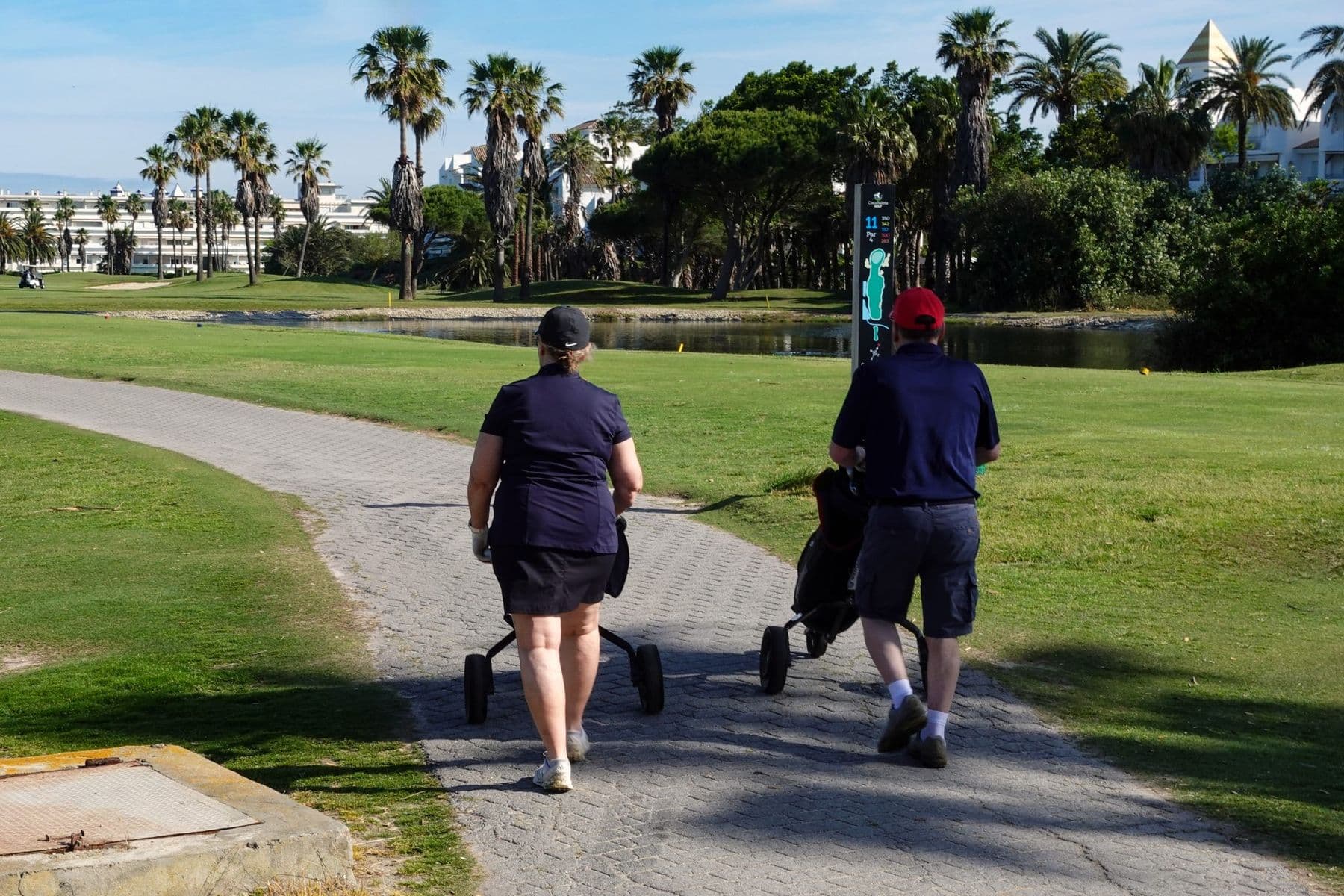
What does survive: a walked round of 18 holes is six to eleven kilometres and four hours outdoors. Three times a month, that is more physical activity than most of the adult population manages.
Here is what it genuinely offers, without the brochure language.
The physical side
You walk far more than you think. An 18-hole course measures 5,500 to 6,500 metres of routing, but you don't walk in a straight line: tee to your ball, ball to green, green to next tee. In practice that is 6 to 11 kilometres depending on how straight you hit it.
It is low-intensity, long-duration activity, which is exactly the kind of effort that is best tolerated sustainably and at any age.
It works rotation and stability. The swing is a rotational movement demanding hip and thoracic spine mobility plus core stability. With one important caveat: done cold or with poor technique, that same demand becomes the problem. The warm-up routine is in how to practise golf.
The detail that changes everything: walking or riding. A buggy turns a two-hour walk into thirty minutes on your feet. Perfectly legitimate, but if you are after the physical side, walk.
An honest note: golf is not intense cardio and it does not replace strength training. It is sustained outdoor activity, and its value lies precisely in being easy to maintain for decades.
The mental side
This is where golf does something few sports do.
Four hours without a screen. Not a small thing. A round is one of very few everyday activities that occupies your attention for hours without digital interruption.
It trains frustration management very directly. In golf the bad shot is constant and unavoidable, even for professionals, and you have to carry on regardless. It is emotional training that transfers off the course better than you would expect.
It forces decisions. Every shot is a decision under incomplete information: distance, wind, risk, your own reliability. Then you get four minutes of walking to live with the consequences. Developed in the mental game in golf.
Contact with a natural setting. Courses are large green spaces, and spending hours in them has an effect on mood that most players recognise without needing it explained.
The social side
Probably the most underrated benefit of all.
Four hours of real conversation. There are not many contexts in adult life where you spend four unhurried, screen-free hours with three other people. It is why so many professional and personal relationships get built on a golf course.
Handicaps let different levels compete. This is the technical point that makes everything else possible: a 54-handicapper and a 12 can play the same stableford match and have it mean something to both. Almost no other sport manages that without one of them being bored.
It is intergenerational. Parents and children, grandparents and grandchildren, colleagues twenty years apart. Same course, same match.
How long you can keep playing
The argument that carries most weight long term: golf can be played at 70 and at 80.
Think of it comparatively. Football, competitive padel, hard running and basketball all have a reasonably clear expiry date. Golf doesn't. What changes with the years is distance — and distance is not what decides a scorecard. Short game, putting and decisions decide it, and those three improve or hold. Developed in senior golf.
A sport you can play for fifty consecutive years delivers more, cumulatively, than an intense one you abandon at forty.
What isn't true
For honesty, and because golf marketing frequently overstates:
- It is not inherently expensive. It can be if you choose it to be. The real breakdown is in how much it costs to start playing golf.
- You don't need to be a club member. Most courses sell green fees to visitors.
- It is not a complete workout. It does not replace strength training or high-intensity cardio.
- It is not just for older people. The average age has dropped noticeably over the past decade.
- It does not require special talent. It requires patience, which is a different thing.
How to start feeling it
The benefits need continuity, not intensity:
| Frequency | What you notice |
|---|---|
| 1 round a month | It is a hobby. The physical effect is marginal |
| 2-3 a month | It becomes regular activity and your game progresses |
| Weekly | Consistent physical activity and clear technical progress |
The real obstacle is logistics, not motivation: finding a course, a time and a price every time you want to play. With Teeup you see real availability and pricing for over 40 courses in Spain and book in seconds, and as a member you play with discounts ranging from 10 % to 60 % depending on the course.
Frequently asked questions
How far do you walk in a round of golf? Six to eleven kilometres over 18 holes on foot, depending on the course and how straight you play.
Is golf good exercise? It is low-intensity, long-duration activity and highly sustainable. It does not replace strength work or intense cardio, but you can keep doing it for decades.
What age can you start playing golf? From 4 or 5 in a play format, with no upper limit. It is one of very few sports playable at 80.
Is golf expensive? Less than its reputation suggests. Playing once a month with your kit already paid for comes to around €800 a year.
Do you need to join a club? No. The vast majority of courses sell green fees to visiting players.
Can players of very different levels play together? Yes, and it is one of golf's great virtues. The handicap system and the stableford format let a beginner and an experienced player genuinely compete.
How long does a round take? Four to four and a half hours for 18 holes walking. Nine holes, a little over two.
Golf's best argument is not any of the above on its own: it is that it combines physical activity, time outdoors and social connection in one activity you can sustain for life.
With Teeup you find courses near you, see the real price before booking and confirm your tee time in seconds.
Download the Teeup app and book your first round.